On a cloudy Sunday afternoon, wandering down the concrete streets of Melbourne’s outer suburbs, you suddenly hear the jolly tempo of Latin music echoing down from an unseen location. Struck by curiosity you chase the sound. Next, the faint sound of chatter and laughter mixes in with the music. With each step you take, the noise gets louder, closer and the curiosity grows stronger. Soon enough you reach the destination, and a smile slowly spreads across your face as you take in the scene before you. Tiny yellow fairy lights twinkle above an open area the size of a small car dealership, spread with bright green artificial turf sprinkled with small wooden tables and matching stools, surrounded by brightly coloured rectangular trucks. Little children are running around laughing as the adults stand around talking, lining up in front of a truck or happily sitting and tucking into all kinds of food including thick cut fries, burgers, kebabs, and gourmet ice creams. As you stand there wondering whether you’ve stumbled upon a secret party, you spot a large colourful sign stamped with the words “The Food Truck Park”. Congratulations, you have just stumbled upon the exciting world of food trucks.

Food trucks are not new; in fact, they’ve been slowly transforming and developing ever since the 19th century. Legend tells that in mid 19th century, in the world of America’s Wild West, a man by the name of Charles Goodnight created a wagon from which he fed cattlemen travelling long distances across the land of freedom. Whether this is the true origin of food trucks or not, we can be sure of two things; mobile food retailing has been around for a long long time and Americans are renowned for it. So how did they start in Melbourne?
Well, it seems that Melbourne first caught the food truck love-bug in 2009, when one of the city’s very first food trucks Beatbox Kitchen was created by Raph Rashid, sparking the Melbourne foodies’ need for deliciously affordable and convenient food. As Rashid’s truck grew in popularity, others who were also passionate about cooking saw an opportunity and began to create their very own food trucks. Fast-forward to 2015 and Melbourne’s street food scene has steadily grown to include numerous food trucks specializing in all types of cuisine from around the world, with the most popular being American-style street food like fresh gourmet burgers and thick cut fries covered in gravy and melted cheese. However, just because American-style food is popular, doesn’t mean that Melbourne food trucks are carbon copies of American food trucks.
Besides being proclaimed as the most livable city in the world, Melbourne is also famous for its vibrant culture of food and fashion. As a result, Melbournians not only like their food to taste good, we also prefer the food retailers to look good as well, even food trucks. Jacqueline Megowan experienced this first-hand when she started her food truck Danger Dogs, which specialises in L.A. style “bacon wrapped hotdogs”. Megowan, who lived and worked in Los Angeles as a pastry chef under the famous Wolfgang Puck, said that “in Melbourne you have to be a very flashy truck”, whereas in Los Angeles it doesn’t matter if you’re a “rusty little shed” as long as your food is great. In fact, Americans commonly refer to food trucks as “roach coaches”, now that is a phrase you’ll never forget.
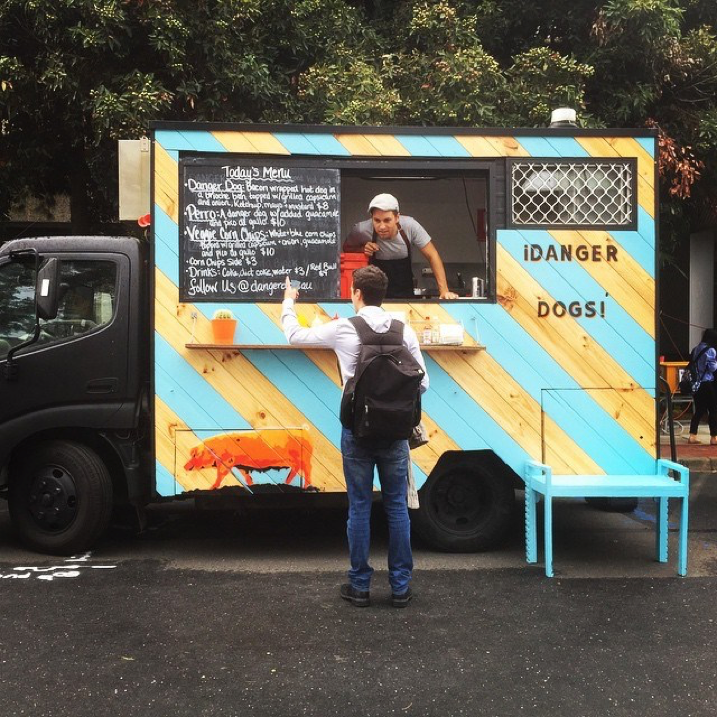
Megowan’s words ring true when you walk around Melbourne food truck hubs such as Welcome to Thornbury, the city’s very first permanent venue for food trucks and their fans. The trucks lining these hubs are covered in colourful designs inspired by their culinary specialisations. For example, Iv’s Burritos created by Ivan Zarezkij in 2013, is covered in Mexican inspired illustrations of orange and yellow flowers, skulls, candles and the silhouette of a little donkey, referencing the literal translation of the Spanish word “burrito”, splashed against its teal coloured walls. Besides its eye-catching design, and fresh handmade burritos deliciously stuffed to the brim with saffron infused rice, black beans, sour cream, tomato salsa, red cabbage slaw and your choice of protein ranging from “smoky BBQ pulled pork” to “cumin spiked tofu and pumpkin”, Iv’s Burritos also attract customers through their warm energetic service, creating a well-rounded experience to remember. So much so that some have even returned to the truck for their anniversary dinner. The ability to create a memorable and positive experience for their customers is something that all successful food trucks have in common.
For Nicholas Stewart, the student engagement coordinator at Monash University, food trucks are all about the experience. “You can create an atmosphere at an event and also provide a food offering…it brings a level of uniqueness to something that otherwise would be very stale and boring” said Stewart who is responsible for organising Monash University’s food truck program. Food trucks “can come in, create atmosphere and provide quite different food at reasonable prices” explained Stewart. According to Simon Bell, a professor of marketing at Melbourne University, affordability also plays into the rich atmosphere created by food trucks, as it allows all types of people “from high court judges to low socioeconomic families” to come together and connect over simple delicious food. However, the most important thing that makes food trucks so popular is the element of fun that they bring into the Melbourne food scene.
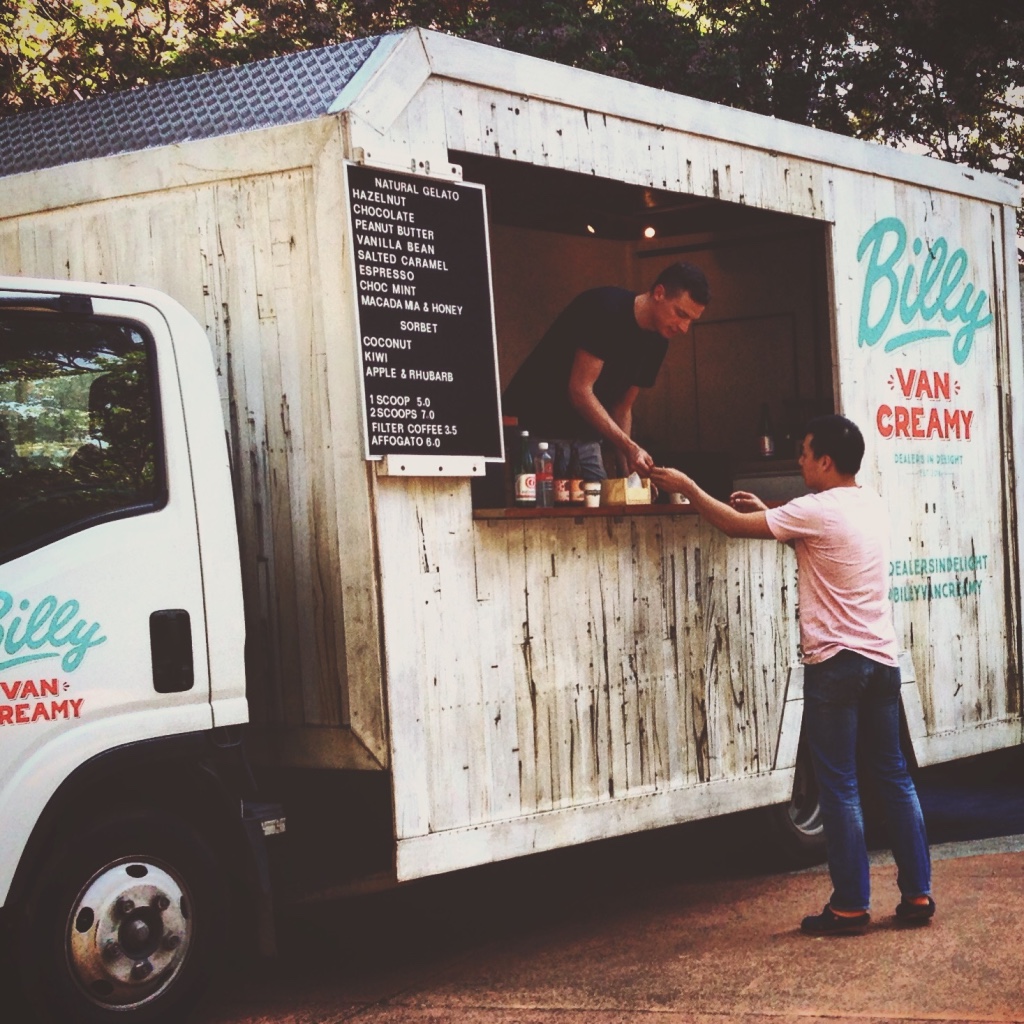
“We don’t take ourselves too seriously” said Jaqueline Megowan who’s truck Danger Dogs feature dishes like the “Chilly Willy”; a spicy bacon wrapped hotdog that’s one of the most popular items on their menu. With slogans such as “you don’t need teeth to eat our meat” which is featured on the Smokin Barry’s food truck, and names like Billy Van Creamy which was inspired by a topless “guy on roller blades, wearing short shorts…and long hair” carrying a boom box, humour and the ability to have fun seem fundamental to running a food truck business. Another fun thing about food trucks is their tendency to pop up at different locations around the city, which are announced daily over social media. This gives their dedicated customers the chance to discover new geographical areas of the city, whilst enjoying scrumptious and affordable food. However, it’s not all fun and games in the world of food trucks. Like any other business out there, they do come across numerous problems on the road to food retailer glory.
The biggest hurdle that food trucks come across is council permitting. The state of Victoria requires all food retailers, including food trucks, to have a valid Food Act registration from their “principal council”, where they trade the most. Additionally, each food truck must have a permit from every council they wish to trade within. “Each council is very very different” said Bill Moragiannis, who is in the process of starting a food truck called Honey Dee’s, specialising in Greek-style donuts called “loukoumades”. “We need authorisation from everywhere and some councils are very hard to get in touch with” said Moragiannis. This is partly due to the complaints councils receive from local fixed food retailers.
“It’s partly reality and partly perception” explained Cr Roberto Colanzi who works in City of Yarra’s Nicholls Ward. According to him, unlike fixed retailers, food trucks “don’t have a lease over multiple years” that they work to pay off, which is one of the points raised by local food retailers in their complaints to the council. Some even bring up the point that food trucks are “not loyal to the area” said Cr Colanzi. However, for Marie Sahinidis, the owner of Melbourne’s first cupcake truck Miss Molly’s Cakes, food trucks are not a big threat to fixed retailers “because we’re not going to be there all the time to take away from their business” said Sahinidis. Simon Bell, a professor of marketing at Melbourne University, agrees with Sahinidis. “A food truck can’t crowd out a restaurant’s business…they provide a completely different experience” said Bell. In fact, from a business perspective the presence of food trucks can have a very positive effect on an area because they generally increase foot traffic and social capital. “Councils need to be braver in making decisions that are in the interests of social capital that is bringing people together in public places” said Bell.
Despite the negative pushback they face from some fixed retailers, food truck owners don’t seem to be worried as they have developed strong friendships with each other. This was a pleasant surprise to Mitch Wells, who worked in several cafés before starting the Billy Van Creamy gourmet gelato truck. “We initially thought that it would be quite competitive between the trucks but…everyone supports each other” he smiled.
With their affordable fresh hand-made food, funky designs and bubbly customer service, food trucks look like they’re here to stay in Melbourne, a city brimming with proud foodies. As for the problems of council permitting, with numerous dedicated food truck parks rolling out their green turf and plugging in their fairy lights all around the city, Melbourne’s food truck revolution looks as if it’s only beginning.
 Zaya's Creations